Day 15 Python Essentials for DevOps Engineers
💼 Senior Software Engineer
What is Python?🐉
Python is an open-source, versatile, and easy-to-read programming language created by Guido van Rossum in 1991. It supports various programming paradigms, making it suitable for various applications.
One of Python's strengths is its extensive standard library and the availability of numerous third-party libraries and frameworks. Notable examples include:
Django: A high-level web framework that encourages rapid development and clean, pragmatic design.
TensorFlow: An open-source library for machine learning and artificial intelligence, widely used for deep learning applications.
Flask: A lightweight WSGI web application framework that is easy to use and scales well for small to medium-sized projects.
Pandas: A powerful data manipulation and analysis library, essential for data science and analytics tasks.
Keras: An open-source software library that provides a Python interface for neural networks, running on top of TensorFlow or Theano.
How to Install Python?⬇️
Windows Installation
Go to the Python website.
Download the latest version of Python.
Run the installer and follow the instructions.
Check the installation by opening a command prompt and typing
python --version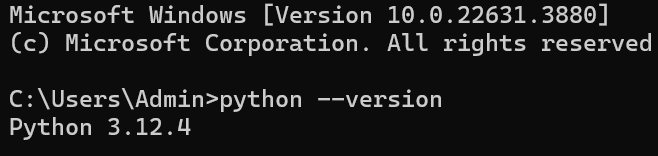
Ubuntu Installation
sudo apt-get update

sudo apt-get install python3.6
Data types in Python⌨
In Python, understanding data types is crucial, as it determines how the language handles different kinds of data. Here's a brief overview of the main data types in Python:
1. Numeric Types
Integer (int): Represents whole numbers
Float (float): Represents floating-point numbers, i.e., numbers with a decimal point
Complex (complex): Represents complex numbers, consisting of a real part and an imaginary part
  # Numeric Types
  x = 10          # int
  y = 3.14        # float
  z = 3 + 4j      # complex
2. Sequence Types
String (str): Represent textual data
List (list): An ordered collection of elements, which can be of different data types. Lists are mutable, meaning their contents can be changed
Tuple (tuple): Similar to lists, but immutable, meaning once created, their contents cannot be changed
  # Sequence Types
  s = "Hello, World!"  # str
  lst = [1, 2, 3, 4]   # list
  tpl = (5, 6, 7, 8)   # tuple
3. Mapping Type
Dictionary (dict): An unordered collection of key-value pairs, where keys are unique. This structure allows for efficient data retrieval based on keys
  # Mapping Type
  d = {"name": "Ketan", "age": 30}  # dict
4. Set Types
Set (set): An unordered collection of unique elements, useful for membership testing and eliminating duplicate entries.
Frozen Set (frozenset): An immutable version of a set, which means that once created, it cannot be modified.
  # Set Types
  st = {1, 2, 3, 4}                # set
  fst = frozenset([5, 6, 7, 8])    # frozenset
5. Boolean Type
Boolean (bool): Represents one of two values: True or False. This data type is commonly used in conditional expressions and logical operations.
  # Boolean Type
  flag = True   # bool
6. None Type
NoneType: Represents the absence of a value
data = None
Conclusion✍
Python offers various data types, including numeric (integers, floats), sequences (strings, lists), mapping (dictionaries), and sets. Mastering these types is crucial for proficient Python programming.